Showing posts with label Movie Review. Show all posts

Monday, 23 August 2021

MOVIE: A New World Order (aka A Living Dog) (2019)


A New World Order (aka A Living Dog) 

Directed by Daniel Raboldt 

Starring Stefan Ebel, Siri Nase 

Hewes Pictures/Nocturnus FIlm 2019 


An unspecified date in the future: Tomasz (Ebel) is part of a troop fighting a legion of mechanical creatures, the A-Mech Mark 8. Created by the Igacho Corporation for the apparent benefit of humankind, these intelligent creatures have turned their attentions to wiping out the entire population and taking over. 

When the soldier next to him meets a nasty end at the hands of the enemy (who are clearly winning this war), Tomasz decides to take the survival option, flees in a VW van and holes up in a remote, abandoned house in the heart of a vast forest. 

It turns out that the house isn’t as abandoned as it looks: Out inspecting a malfunction in his portable forcefield (now there’s a handy gadget), Tomasz gets a full-on whack around the mush from some heavy-duty kit wielded by Lilja (Hase), who is holed up in the woods obsessively tinkering with parts from disassembled A-Mechs when a bound and gagged Tomasz eventually comes around. 

Lilja is Russian, but it’s just as well that the two don’t speak the same language for the A-Mechs pick up on their prey by detecting the sound of their voices. Without the benefit of verbal communication, Tomasz faces the difficult task of demonstrating to a clearly suspicious Lilja that he is not a threat to her, whilst working out how to evade and survive the threat from the A-Mechs.

Meanwhile, Lilja has a bigger plan in mind… 
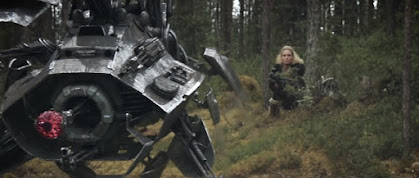

Lilja (Siri Nase) confronts an A-Mech in A New World Order (aka A Living Dog) (2019)

Originally going by the less prosaic (if possibly more intriguing) title of A Living Dog, the renamed A New World Order comes to UK screens two years after it debuted on the festival circuit. It’s by no means the only film to have its distribution disrupted by global events beyond its control, but I would say this one has been well worth waiting for. 

The creatures are like a more angular cross between the fighting machines of Jeff Wayne’s musical version of War Of The Worlds (1978) and the BBC’s take on John Christopher's The Tripods (1984-85), and they are very impressive on the screen, especially when one considers that A New World Order is a very small independent production, initially supported through a Kickstarter campaign. 

Ebel and Nase do fantastic work in the leads, entirely mute save for one repeated line each – you can totally believe the difficulties with expressing and explaining themselves to each other, and the two get enough of the anguish from their characters’ back-stories across to make for some truly poignant moments without bogging down the film in unnecessary diversions. 

This is demonstrated no better than when we learn that Lilja has suffered a deep personal loss in this war – the bare details we have are enough for us to feel for her. No further explanation is needed. Likewise, a brief flashback to a terrible act by Tomasz as he flees the warzone is enough to make us think a bit more about our view of him. 

Ultimately a tale of (to a certain extent) tragedy and (to a larger degree) redemption, Daniel Raboldt’s film is a textbook exercise in getting one hell of a lot out of very little. It’s tempting to wonder what he could pull off with bigger resources, but the sheer economy of scale works so well in the favour of A New World Order that my selfish side wants to see what else he could pull off with similar restraints. 

In a nutshell, A New World Order is an effective little gem. 

A New World Order is out on UK digital platforms from Reel 2 Reel Films on August 23rd 2021.


FOOTNOTE: Just a point to consider for anyone thinking “Enemy creatures picking up the sound of the human voice? A Quiet Place did that already!” – Work on this film began in 2016, a full two years before A Quiet Place was released.


MOVIE: Random Acts Of Violence (2019)


Random Acts Of Violence 

Directed by Jay Baruchel 

Starring Jesse Williams, Jordana Brewster, Jay Baruchel, Niamh Wilson, Simon Northwood 

Elevation Pictures/Manis Film/Kickstart Productions 2019


“Nobody ever talks about the victims, and those are the people who matter!” 

It’s a pertinent point, one which put me in mind of Hallie Rubenhold’s The Five, the book in which the writer cast a spotlight on Jack The Ripper’s victims and effectively challenged the tendency of the true crime genre to focus its energies on the mindset of the killer and treat the victims as less important, passing two-dimensional characters. 

It’s perhaps the conflict between a voracious public appetite for serial killer stories and the comparative lack of interest in the detailed backgrounds of their victims that underpins Random Acts Of Violence, where the above point is raised by Kathy (Brewster): She’s working on a serious study of a series of killings which (in this film’s universe) took place on a stretch of Interstate-90 from 1989 to 1992. Her husband, Todd (Williams) has taken a very different inspiration from the same events, for the perpetrator of those crimes is represented as anti-hero Slasherman, the star of Todd’s long-running comic book series. 

The pair have been travelling along that same stretch of highway to attend a comic-con where Todd is doing the usual meet-and-greet duties for a queue of adoring fans, and the two have been joined by Todd’s friend Ezra (Baruchel) and assistant Aurora (Wilson). When the travelling party pulls into a ramshackle gas station en route, Ezra thinks it might be a wheeze to restock the store’s depleted magazine rotunda with some of Todd’s back-issues of Slasherman. 

A later customer browses the impromptu comic display and takes a particular interest in the Slasherman volumes, and when Todd is being interviewed for a radio phone-in, a cryptic call (claiming to be from someone sharing the name of one of the killer’s earlier victims) gives the coded message: “1, 12, 18”. 

It heralds the beginning of a new series of murders on I-90, which mimic scenes from some of the more grisly comic panels. The mimicry is pulled into sharp focus when the travellers get a close-up glimpse of the aftermath of a group slaying, and the killings gradually get closer to home. 

As Todd faces accusations that his fictional killings might be inspiring real-life acts of violence, there are times when one wonders whether Random Acts Of Violence concurs with that viewpoint and is effectively biting the hand that feeds it: Fans of horror comics, or horror movies for that matter might occasionally feel like the script is having a go at them. 

Still, I would argue that the ultimate revelation of the real reason why the killings have resumed not only subverts that notion but casts a very different light on Todd’s motivations for creating the comics in the first place, and it still seems fair game to point at the more unnerving end of fandom when a fan proudly shows off his hand-crafted model of Slasherman’s truck, complete with a very carefully detailed, miniature torture victim tied up in the trailer – after all, haven’t we all encountered that fan who takes it just that bit too far? 

The moral viewpoint may shift throughout the film, but perhaps that’s the point. With its admirable subversion and challenging of slasher tropes, and some genuinely unsettling and tense moments Random Acts Of Violence is the kind of film that starts a conversation once the credits roll, and it's a conversation worth having.

Random Acts Of Violence is out on blu-ray in the UK from Acorn Media on August 23rd 2021.

MOVIE: Eye Without A Face (2021)


Eye Without A Face 

Directed by Ramin Niami 

Starring Dakota Shapiro, Luke Cook, Vlada Verevko, Rebecca Berg, Ashley Elyse Rogers, Evangeline Neuhart, Sarah Marie. 

Sideshow 2021


Henry (Shapiro) lives a mostly solitary life, indulging in the dubious practice of monitoring several local ladies whose webcams he has hacked into. Henry holds one-way conversations with them as though they are close acquaintances but the only meaningful in-person interaction he has is with his lodger, out of work actor Eric (Cook) who imagines that he can trade off his lack of rent by offering Henry friendship of sorts. 

The girls that Henry watches over are a disparate group: there’s online influencer Ella (Marie), musician-in-a destructive-relationship Sky (Neuhart) and Tessa (Rogers), a webcam model who argues on the phone with her mother about her chosen profession. 

Their day-to-day lives are overshadowed for Henry by that of Laura (Verevko), who seems to have a string of short-lived boyfriends in the truest sense of the term, since they are seen being taken upstairs but never seen leaving. Putting the available evidence together in his head, Henry is convinced that he is watching a serial killer at work, a notion only confounded when he sees her dragging what appears to be a corpse-packed bin bag across the living room. 

Questions are raised as the film progresses: Is Henry putting two and two together but coming up with five? Does he have his own demons to deal with? Is there more than one killer at large? 

Eric takes drastic steps to convince Henry that the whole thing is a flight of fancy, fuelled by his insular and obsessive pastime and even goes so far as to bring him face-to-face with one of his online coterie but, as things reach a head it’s clear that (for a few characters at least) this spiralling situation is not going to end well… 

The script aims at ambiguity over who is perpetrating what but ends up becoming somewhat muddled, and the contrasting elements of voyeuristic horror, slasher mayhem and what verges on buddy-com banter between Henry and Eric never quite manage to reconcile. Still, for all that Eye Without A Face is still a worthy attempt to shake up some familiar ingredients: Rear Window (1954) is an obvious reference, and there is also a climactic moment which is akin to an up-to-date take on Peeping Tom (1959). 

Also on the plus side, the presentation is striking with a top notch lead performance from Dakota Shapiro, sparking memories of Elijah Wood’s turn in the Maniac redux (2012). Even if it doesn’t quite manage to coalesce its parts into a truly satisfying whole, Eye Without A Face has more than enough going for it to merit your investigation. 

Eye Without A Face is out on UK digital platforms from 101 Films on August 23rd 2021.

Monday, 16 August 2021

MOVIE: Scare Me (2020)


Scare Me 

Directed by Josh Ruben 

Starring Josh Ruben, Aya Cash, Chris Redd, Rebecca Drysdale 

Irony Point/Artists First 2020


When writer Fred (Ruben) checks in to a remote cabin in an attempt to break his writer’s block, he meets another writer, Fanny (Cash) who is staying nearby. When a power cut hits the area on a stormy night, Fanny drops-in and the two decide to pass the hours by regaling each other with scary stories… 

So far, it’s the ideal set-up for a horror anthology picture, but Scare Me has a nice twist up its sleeve: Where one would expect the scene to cut away elsewhere for a cast of players to unwind each tale, the action instead unfolds within the cabin as Fred and Fanny act out their tales, at first individually but the process becomes an increasingly collaborative one as the film progresses. 

There’s an interesting undercurrent to the interplay between the two: Fanny is already a success with a bestseller under her belt, while Fred is struggling to reach first base with his premiere effort and it’s interesting that Ruben has made his feature debut as writer/director by casting himself as someone who clearly can’t put his ideas across successfully: Fanny can’t help herself in correcting his grammar, pointing out his plot holes and interjecting with her own improvements. 

A break between tales reveals a message on Fred’s phone that indicates a personal life in disarray, making his attempt at an artistic breakthrough all the more desperate. Any potential tension from that revelation is temporarily dispersed by the arrival of a much needed pizza, delivered by Carlo (Redd), a horror-fan who is awe-struck by the revelation that Fanny is the author of his favourite book. 

Carlo joins in for a stimulant-fuelled run-through of Fanny’s novel but, with his eventual departure to continue his rounds the chasm between Fred and Fanny’s respective lives and achievements becomes all too clear and the storytelling takes a darker turn as dawn approaches… 

Ruben and Cash bounce off each other brilliantly – indeed, the cast dive into things with aplomb and there’s the feeling (in a good way, I assure you) that there was a fair bit of spontaneous wordplay flying around this set. 

Scare Me perhaps carries on too long for its own good (dare I say most of the pizza-delivery-guy section disrupts the flow and could have been dropped?), the disjointed nature makes for an uneven ride and the final gear shift into more chilling territory doesn’t quite have the impact it should, but that’s not to say that the denouement isn’t a satisfactory one by any means. 

Genre fans will enjoy the references to various touchstones (Poltergeist, Halloween, Jaws and many more are namechecked) and regardless of any reservations noted above, for its refreshing take on the horror anthology idiom Scare Me is a fascinating feature debut well worth seeing – I’m certainly intrigued enough to seek out Ruben’s filmic take on video game Werewolves Within (2021).


Scare Me is available on UK blu-ray from Acorn Media from August 16th 2021

Sunday, 2 May 2021

MOVIE: We Still Say Grace (2020)


We Still Say Grace 

Directed by Brad Helmink and John Rauschelbach 

Starring Bruce Davison, Holly Taylor, Rita Volk, Arianne Zucker, Dallas Hart, Frankie Wolf, Xavier J. Watson 

Dauntless Studios/Lexicon Entertainment 2020


When three students on a road trip get a flat tyre in the middle of nowhere, they call in at a farm looking for help. It’s the home of Harold (Davison), a religious zealot who rules his family with a rod of iron and has a take on Christianity which is unorthodox to say the least. 

Unbeknownst to the three, Harold has been doing a dry run for a suicide pact between himself, wife Betty (Zucker) and daughters Maggie and Sarah (Taylor and Volk respectively). Maggie, however seems somewhat resistant to this plan and the visitors  offer a window to a different world… 

There’s a nice wrong-footing of the audience early on, as the opening scenes give the impression of a frontier family in the old west before a white Cadillac appears and the stark contrast between the residents and visitors becomes apparent. 

It’s not long before Harold is revealed to be a hypocrite, and an unsound one at that. Just how dangerous he is becomes clearer as Maggie, somewhat liberated by her contact with the outsiders begins to question and challenge her way of life. 

The “stranded travellers find themselves taken in by fundamentalist nutter” strand is a well worn one, but the script by directors Helmink and Rauschelbach throws some interesting curveballs during its 94-minutes and the pair do a good job of keeping the spiralling situation just the right side of going off-piste. 

There are strong turns all-round from the cast, particularly the female performers making up Harold’s family but it’s Bruce Davison (always a great asset to any production) who provides the perfect vehicle for them to bounce off with a performance which is alternately disturbing and infuriating, such does he get under the skin of this repellent individual. His interaction with Holly Taylor in the latter part of the film, where the two mentally square-off against each other raises We Still Say Grace a very large notch above the usual religious-fanatic chiller.


We Still Say Grace is released to UK digital platforms by 101 Films on May 3rd 2020.


Saturday, 24 April 2021

MOVIE: The Deadly Bees (1966)


Appropriately for a spring Saturday, the bees are coming in 1966's The Deadly Bees - I'm taking a look at Amicus' foray into creature features at Spooky Isles. Read more at https://www.spookyisles.com/the-deadly-bees-1966 

Saturday, 17 April 2021

MOVIE: Darkroom (1989)


Darkroom

Directed by Terrence O'Hara 

Starring  Aarin Teich, Jill Pierce, Jeff Arbaugh

Omega Entertainment 1989 

After committing a brutal double axe murder, an unknown assailant targets a large family in a remote house. Tensions rise as it becomes apparent that the killer may be someone close to them, looking for revenge after they traumatically saw two family members indulging in lewd behaviour as a child... 

Here's one I last saw on a VHS from Guild Home Video (remember them?) and had forgotten all about until a recent Bluray release. It all starts off promisingly with some creative titles which display the credits on the ephemera of a photo lab (negatives, photo paper and the like) before heading into an opening killing which indicates we might be in for a giallo-esqe hour and a half.

Unfortunately, Darkroom is promising more than it delivers and things drop off rapidly from there. The following half hour or so is a bit of a chore to sit through before things do admittedly pick up, but for a slasher flick we don't see much actual slashing going on.

Manwhile, Darkroom's murder-mystery elements fall flat through some all too obvious red herrings and dialogue which really should have been through another script revision before the cameras rolled - the obligatory-for-the-late-80's nude/scantily-clad shots do little to keep the audience's attention.

Still worth a look as one of the more forgotten entries from producer Nico Mastorakis' filmography - I'm sure some of the settings (i.e. the orange groves) look very familiar from his more impressive production of the previous year, Grandmother's House. Also, the final humility heaped on the killer in the closing moments is a nice ironic touch - it's a pity it wasn't utilised in a stronger film.

Saturday, 10 April 2021

MOVIE: Nightwing (1979)


Nightwing 

Directed by Arthur Hiller 

Starring Nick Mancuso, David Warner, Kathryn Harrold, Stephen Macht, George Clutesi 

Columbia Pictures 1979

Maskai tribal lawman Youngman Duran (Mancuso) is at odds with neighbouring tribesman Walker Chee (Stephen Macht) when a mining company wants to extract shale reserves from sacred burial grounds. 

Tribal elder Tasupi (Clutesi) launches his own offensive against the plans by unleashing dark forces in the form of vampire bats, and horses and livestock are attacked. Meanwhile, Duran’s doctor girlfriend Anne (Harrold) has headed out into the desert with a tourist party which soon comes under siege from the winged menace, and it seems that biologist Phillip Payne (Warner) may be the only person with the know-how to get rid of it…   

From the director of Love Story (I kid you not) came this quite puzzling bats-on-the-attack feature, another 70’s entry in the animals-gone-wild cycle (see Jaws, Grizzly, Piranha et al) which starts out with an intriguing premise and some lofty ambitions to spotlight the concerns of Native Americans, then blows it all by casting a Canadian-Italian and a Philadelphian of Russian descent in the leading roles – Hollywood was apparently still no more comfortable in employing indigenous tribespeople in starring roles than it was when German-born Henry Brandon was cast as Chief Scar in The Searchers (1956). 

That aside, Nightwing is strangely lacking in any real tension or menace and there are some utterly baffling editing decisions on display. Some scenes seem to haphazardly jump to the next without reaching any kind of climax and the script’s socio-political points feel like they’ve been shoehorned in from a checklist. 

Then there are the actual attack sequences… The appalling matte work is one thing (you could be forgiven for thinking Bert I. Gordon had been involved), but the bats themselves are ridiculous, like Halloween toys on sticks. It’s a shock to see that they’re the work of Carlo Rimbaldi (Alien, E.T.,King Kong) and one can only wonder what went wrong in their execution. 

At least the audience can depend on David Warner: An actor who could always be relied upon to put in a decent shift, his fanatical bat hunter is by far the most interesting thing in the film, since the remaining characters (with the exception of a brief turn from Barnard Hughes as the local storekeeper) are as dull as the bat attacks are risible. 

For all that, Nightwing still has some curiosity value as a historically interesting, albeit clumsy attempt to bring some social consciousness to the form of the creature feature. It’s beautifully shot by Charles Rosher and there’s even a score from Henry Mancini which would have no doubt aided the atmosphere of a better film – it’s wasted here, and it’s somewhat bewildering that such a prestigious team ended up creating something so middling.

Sunday, 21 March 2021

MOVIE: Reunion (2020)


Reunion 

Directed by Jake Mahaffy 

Starring Julia Ormond, Emma Draper, John Bach, Cohen Holloway 

Greyshack Films/Miss Conception Films/Overactive Imagination/Water's End Productions/ New Zealand Film Commission 2021 

Ellie (Draper), pregnant and apparently fleeing an abusive relationship returns to the home of her recently deceased grandparents where her estranged mother Ivy (Ormond) is boxing up belongings in preparation for a house sale. 

It seems that a reconciliation between the two might be possible, but there are unresolved matters from the past: The death of a half-sister in the house still hangs heavy in the air, and as the details seem to become clearer to Ellie in increasingly nightmarish flashbacks an even darker family secret reveals itself…

Those in search of a cut-and-thrust horror ride can look away now, for Reunion is a slow burn indeed, driven for the most part by an intense two-hander between Ormond and Draper (who both acquit themselves admirably), gradually revealing the layers of a troubled mother/daughter relationship. Meanwhile, Ellie’s memories of past traumas are slowly revealed through a series of partly repetitive, partly contradictory flashbacks, perhaps fuelled by Ellie’s withdrawal from possibly emotion-numbing medication. 

Ellie and Ivy’s uneasy interaction is interrupted only by Ellie’s incapacitated father Jack (Bach) and local architect (and Ellie’s old flame) Gus (Holloway) who has been hired to spruce the place up before it’s sold on. The stroke-ravaged Jack may initially draw the viewer’s sympathy for his current situation, but as his past misdemeanours are steadily divulged one can’t help feeling that he’s gotten no less than he deserves. 

The most prominent character of all in Reunion may be the house itself, its faded grandeur captured with fantastic camera work (by Adam Luxton) which imbues this seemingly benign structure with a malevolent personality of its own, one which signposts the skeletons hanging in the collective family closet. The air of melancholy manifests itself in the most literal fashion as black bile, be it on Ellie’s person or from the house’s ageing water pipes. 

The pacing won’t be to everyone’s taste, indeed this is one of those films which will likely divide opinion right down the middle but those in the right frame of mind will be rewarded with a big climactic gear change into a conclusion which paradoxically manages to be both revelatory and ambiguous: Ellie, after all has demonstrated herself to be an unreliable witness throughout the film and the viewer’s search for the real facts leaves Reunion lingering in the mind and inviting a second look. 

Reunion is released on digital by 101 Films on March 22nd 2021

Sunday, 31 January 2021

MOVIE Escape In The Fog (1945)


Escape In The Fog

Directed by Budd Boetticher (as Oscar Boetticher Jr.)

Starring Nina Foch, Otto Kruger, William Wright, Konstantin Shayne

Columbia 1945

San Francisco, 1945. Army nurse Eileen Carr (Foch) is on extended leave due to nervous exhaustion. She has a nightmare in which she sees a man being murdered near the Golden Gate Bridge, but on awakening she sees the dream victim, federal agent Paul Devon (Kruger) standing before her.

The two subsequently strike up a budding relationship, but when Paul is given a special, dangerous assignment Eileen begins to fear that her dream is turning into a prophecy, and unfolding events do nothing to placate her fears...

Escape In The Fog kicks off the intriguing and welcome collection Columbia Noir #1 from Powerhouse Films and whilst it's debatable whether it quite qualifies as a Film Noir per se (it's mostly free of the cynicism one would associate with the form, and there's never any feeling that a downbeat ending might be on the cards), it's nonetheless a fascinating wartime B-thriller from the last days of World War II (indeed the war was over by the time Escape In The Fog reached the UK).

The film's noir credentials mainly come from the dream sequence and other fog-bound scenes set at the waterfront, which add an eerie dimension to proceedings and raise it a notch above most propaganda pieces from the period. Columbia contract player at-the-time Nina Foch (Return Of The Vampire (1943), Cry Of The Werewolf (1944)) does sterling work in the lead and, if it doesn't spring too much in the way of surprise plot twists Escape In The Fog still stands up nicely as a solid Sunday afternoon matinee selection.


Friday, 30 October 2020

MOVIE: Circus Of Horrors (1960)


Circus Of Horrors

Directed by Sidney Hayers

Starring Anton Diffring, Erika Remberg, Yvonne Monlaur, Donald Pleasence, Jane Hylton, Kenneth Griffith, Conrad Phillips, Jack Gwillim, Vanda Hudson, Yvonne Romain, Colette Wilde

Lynx Films/Independent Artists/Anglo-Amalgamated 1960

Dr. Rossiter, a gifted if somewhat maverick plastic surgeon, is on the run after his work on Evelyn Morley Finsbury has gone awry. She has been missing following her surgery. When her husband finds her, she has trashed every mirror in her room. She is horribly scarred and laughing maniacally[1].

Meanwhile, Rossiter drives straight through a police roadblock, before swerving off the road and down an embankment. He survives, but has sustained facial injuries. Making his way on foot to his two assistants, brother and sister Martin and Angela, Rossiter gets himself patched up before the trio take flight to France. There they come across a young girl by the side of the road: Nicole has been facially scarred by an explosion during the war, and she takes the three to her father Vanet, the owner of a derelict circus which has fallen on hard times.

Sensing the perfect cover for his ongoing experiments, Rossiter (now going under the pseudonym of Dr. Schuler) agrees to treat Nicole in return for shared ownership of the circus. A grateful Vanet agrees, but just after the deal is made he drunkenly decides to perform a celebratory dance with his performing bear. When the bear steps on some broken glass and turns vicious, Vanet is mauled. Schuler/Rossiter looks like he is about to intervene, before holding back and leaving Vanet to his grisly fate. Schuler is now in sole charge of the circus.

Heading into town for a drink, Schuler spies a prostitute named Elissa in a bar, preparing to rob a potential client (Schuler sees her concealing a knife in her cleavage). He witnesses her taking the hapless punter’s wallet in an alleyway before brutally stabbing him. As she flees, Schuler stops Elissa in her tracks. Seeing that she bears a knife scar on her face, he offers to help her both with surgery and in evading the police.

Angela questions why Schuler should want to help her. He reasons that such a person is perfect for their circus, as she will not blow their cover and will be forever indebted to the doctor. He plans to find more such subjects, to surgically heal before training them as performers. “A circus of criminals?”, asks Angela. “No”, replies Schuler. “A circus of beauty!”

At this point, the story jumps ten years, and the glamorously transformed circus arrives in Berlin[2]. Angela, who has been hopelessly in love with the doctor since the film began and beyond, now finds herself marginalised, whilst Martin has been essentially reduced to assisting Elissa, who has honed an impressive aerial rope act in the intervening years[3]. Elissa’s not happy at playing second fiddle to Magda von Meck, whose horse-riding act involves riding through an archway made from razor-sharp swords.

Magda has decided to leave the circus, to marry a well-off gentleman who promises a life of luxury. Schuler isn’t happy with this betrayal, and since we are led to believe that he has arranged a series of accidents for previous ingrates[4], Magda should be wary before engaging in her other role, as the assistant in a knife-throwing act…

There’s enough here already to fill the duration of many movies, but we’re only 37 minutes in! Proceedings now shift up another gear: Schuler takes on another performer, much to Elissa’s chagrin, and takes the show to England, where he plans to finally unveil his medical work. Martin and Angela finally pluck up the courage to turn against Schuler, the police finally twig that the series of deaths in the circus may not have been accidents after all, and a figure from Schuler’s previous life as Rossiter re-appears, leading to the film’s final showdown[5].

Naturally, in today’s climate the deaths in Circus Of Horrors will inevitably seem quite tame, but what is worth noting is how much it seems to focus as much on titillation by scantily-clad females as it does on shocking the audience with its gruesome deaths. It is sold just as much on sexual appeal as on its horrific elements. The blatant display of female flesh is almost as giggle inducing as it is mildly shocking in these more politically charged times.

And yet, Circus Of Horrors is still a rollicking ride. Director Sidney Hayers simply acts like the most ludicrous of plot elements are perfectly normal, and just gets on with things. This approach perhaps made him a perfect choice for helming episodes of The Avengers a few years later. Never mind that the film expects us to believe that any street criminal can be fixed-up and turned into an acrobatic performer by a deranged plastic surgeon. This is the British horror film – you either buy into it, or you don’t. 

Circus Of Horrors hit UK cinemas in April of 1960, and would (no doubt to the annoyance of highbrow critics and self-appointed guardians of public morals) do very well indeed, following on from Anglo-Amalgamated's equally reviled Horrors Of The Black Museum (1959). The following month, Anglo’s next release would have considerably less in the way of good fortune. Peeping Tom would cause a critical outcry, performed badly and only got the briefest of theatrical releases before being pulled from distribution completely. A brief window of leniency from the BBFC was abruptly shut, and screen horror in the UK would be noticeably toned down for the next few years.


FOOTNOTES:

[1] To be fair, the doctor has warned Evelyn that one operation will not suffice, and that she will require several over a period of at least a year. She ignores this advice, and removes her bandages too soon. If she had listened to her doctor’s orders, the chain of events which follows might well have been avoided, but then we wouldn’t have much of a movie.

[2] Billy Smart’s Circus stood in for Schuler’s enterprise from this point in the film.

[3] Elissa’s act is accompanied by Look For A Star, as performed by Garry Mills. This saccharine ditty is played incessantly throughout the remainder of the film, an act of earworm-inducing product placement which evidently paid off: The tie-in single on the Top Rank label would reach number 7 in the UK. In the USA, it reached number 26, fighting against competition from no less than three rival versions, including one by a singer who cheekily adopted the similar-sounding pseudonym of Garry Miles.

[4] We don’t get to see most of these, sadly. But then, with an on-screen body count of 6 (or 7, if you include one of the circus animals) the BBFC probably felt they’d allowed quite enough.

[5] Reading back through this synopsis, it does strike me how ridiculous this looks on the page, and highlights how lucky Britain was to have actors of Diffring’s calibre on hand to appear in these films. Lesser talents could never have pulled them off with such élan.

Wednesday, 28 October 2020

MOVIE: I See You (2019)


I See You

Directed by Adam Randall

Starring Helen Hunt, Jon Tenney, Judah Lewis, Owen Teague, Libe Barber, Gregory Alan Williams

Bankside Films/Head Gear Films/Kreo Films/Zodiac Features 2019

Following the disappearance of a small boy, the investigating officer and his family are affected by a series of strange happenings. There may be a link to a series of child disappearances some years earlier, but matters are further complicated by the infidelity of the officer's wife, and the couple's attempts at reconciliation.

This is one smart little chiller-thriller, its first half cranking up an unnerving atmosphere, leaving you wondering how it can sustain it for the second half.

The thing is, the film doesn't sustain it. In fact, it wilfully changes tack completely in the most surprising manner, putting a totally different complexion on the events of the first half. Character motivations are revealed to be nothing like they may have seemed, the true source of some of the stranger phenomena is unexpected and it's a chilling reveal when we learn the identity of the true villian of the piece.

We don't get to find out fully what has happened in the child abductions (past and present), but Devon Graye's screenplay leaves enough scraps of detail scattered around for us to fill in the gaps and go to some very dark places.

Perhaps not one for those looking for a quick horror fix, the more patient viewer will be amply rewarded. Deftly structured and executed, with all-round excellent performances, I See You kept me hooked and wrong-footed in equal measure right to the end, and is certainly one of my favourite releases of the past year.

Sunday, 30 August 2020

MOVIE: Plot Of Fear (1976)


Plot Of Fear

aka E tanta paura, aka Bloody Peanuts

Directed by Paolo Cavara

Starring Michele Placido, Corinne Cléry, Eli Wallach, Tom Skerritt

Centro Produzioni Cinematografiche Città di Milano/G.P.E. Enterprises 1976

On the same night, a female prostitute strangles her client, while a woman is battered around the head with a spanner on a deserted bus. The only link: at the scene of both murders, illustrations from a children’s book called “Shockheaded Peter” have been left behind.

When more murders occur, again marked with illustrations from the same book, the victims are linked back to an elite group calling itself Wildlife’s Friends. Inspector Lomenzo (Placido) is assigned to investigate.

There’s a decent giallo struggling to get out of this one, a frustratingly laboured effort from the director who just five years earlier had given us the rather good Black Belly Of The Tarantula (1971). The dialogue scenes frequently fail to sparkle and the attempt to liven-up proceedings with soft-core sex is all too symptomatic of the original cycle’s death throes. Even the murder scenes don’t quite hit the mark as they should. Things do improve considerably towards the climax, but even by the genre’s standards the denouement will take a bit of work to get your head around.

On the credit side, Michele Placido makes for an engaging force of law and order (at least when he manages to keep his clothes on), while Eli Wallach (despite being dubbed in both Italian and English versions by someone who sounds nothing like Eli Wallach) adds some welcome gravitas, as the head of a video surveillance firm who may or may not be helping the police with their enquiries.

By contrast, Corinne Cléry (fresh from a notorious appearance in The Story Of O (1975)) is mainly required to add titillation value and get naked on occasion. Tom Skerrit has very little to do and is likely just there to add another recognisable name for English-speaking territories.

Ultimately, Plot Of Fear is not without interest: it at least piques curiosity as a halfway house between the giallo cycle and the cop thrillers which would supersede it as an Italian cinema staple, but also highlights just how much the form was losing its way by the latter part of the decade.

Monday, 24 August 2020

BLU-RAY: Walkabout (1971)


Walkabout

Directed by Nicolas Roeg

Starring Jenny Agutter, Luc Roeg (credited as Lucien John), David Gulpilil (credited as David Gumpilil)

Max L. Raab-Si Litvinoff/20th Century-Fox 1971

When a man takes his teenage daughter and younger son for a drive into the outback for a picnic, things take a shocking turn as he attempts to shoot them. Failing to do so, he torches the family car and turns the gun on himself.

The abandoned children are left to fend for themselves, as they try to make their way back home, or at least to familiar surroundings. They meet an aboriginal boy, who is on his traditional rite of passage (the “walkabout” of the title). Despite not being able to communicate verbally through their language barrier, the boy teaches them how to survive in their unfamiliar and harsh environment.

Walkabout is released on Blu-Ray in the UK by Second Sight on August 31st 2020, so what better opportunity to revisit a film which stuck in my mind from my formative years of film watching, and has revealed more of its facets with subsequent viewings. My memory deceives me that it was on television frequently in my childhood, although a bit of digging reveals that the BBC screened it three times in that period. In the times before we had a video recorder, we must have watched all those screenings in our house.

Naturally, there were elements of the film that failed to register with me at that age. In that sense, it has always felt like the film has grown with me. My younger self viewed it simply as a tale of two stranded children trying to make their way back home, but revisiting Walkabout through the passing years revealed it also to be a tragic tale of cultures clashing, as well as an allegory of modern civilisation moving away from a simpler, perhaps more natural means of existence. As Jenny Agutter says in a fascinating interview included on this Blu-Ray release:

“It tells [its] story both very simply, but with all of the different layers as well. It’s very hard to say exactly what it’s about. You know, people say “what’s the film about?” I think, to me it’s about loss of innocence.”

At this distance, the casting is fascinating. Agutter was yet to make her breakthrough film, that perennial evergreen The Railway Children, although Walkabout would actually end up being released after that particular film. The casting of Roeg’s own son Luc may well have raised a few eyebrows (and might explain the pseudonym on the credits), but it perhaps makes sense that the child in a challenging role should have absolute trust in the director from the off – how better to have this than when the young actor’s father is in charge?

Also making his film debut here was David Gulpilil (curiously credited as David Gumpilil). His performance as the boy on walkabout is so astonishing that it’s truly a puzzle that he didn’t appear in another film for five years, when an impressive triumvirate of Mad Dog Morgan, Storm Boy (an AACTA nominated performance) and The Last Wave all followed in quick succession.


The Blu-Ray:

Walkabout gets the lavish treatment it deserves in Second Sight’s superb release. It is unquestionably one of the most beautifully shot films of its time, and the 4K scan and restoration allows Nicolas Roeg’s cinematography to shine.

Special features include a new audio commentary with Luc Roeg and David Thompson, new interviews with producer Si Litvinoff, Luc Roeg and Jenny Agutter, a new interview with Danny Boyle discussing Nicolas Roeg’s work, a 2011 BFI Q&A with Nicolas Roeg, Jenny Agutter and Luc Roeg and an archive introduction by Nicolas Roeg. The main feature also has optional subtitles.

The limited edition box set (3,000 copies) comes with new slipcase artwork by Michael Boland, a copy of Donald G. Payne’s original novel (with unique cover art), a facsimile copy of the original 65 page First Draft Script with preface by Daniel Bird and an additional book with new essays by Sophie Monks Kaufman, Simon Abrams and Daniel Bird, along with stills and lobby card images.

In conclusion:

Walkabout, along with the same year’s Wake In Fright were very much films made from an outsider’s view of Australia (and it’s fascinating to contrast and compare the two films), but they are frequently cited (and with good reason) as kicking off the new wave in Australian cinema, as indigenous filmmakers began to tell their own stories, and with government backing.

The word “seminal” may be somewhat too casually applied to some films, but in the case of Walkabout it is perfectly apposite. It is a shame that a documentary on the career of David Gulpilil (included with an earlier US release) couldn't be included here, but that's a relatively minor quibble overall. The wealth of supplementary materials included with this edition, both on the disc and in the package make up what must be the near-definitive document of this quite unique film, and another fine Second Sight release.

Walkabout is available directly from Second Sight Films for pre-order, released on August 31st 2020. Click HERE to visit the product page (opens in new window).

Sunday, 23 August 2020

MOVIE: The Red Queen Kills Seven Times (1972)


The Red Queen Kills Seven Times

aka La damma rossa uccide sette volte

Directed by Emilio Miraglia

Starring Barbara Bouchet, Ugo Pagliai, Marina Malfatti, Sybil Danning

Phoenix Cinematografica/Romano Film/Traian Boeru/Cineriz 1972


A prophecy (portrayed in a family painting) dictates that there is a curse on the Wildenbrücks: Every 100 years two sisters will grow to hate each other. One (depicted as the Black Queen), will kill the other (known as the Red Queen). The prophecy says that the Red Queen will then return, killing seven times to avenge her death.

For the current generation of the family, the prophecy seems to be working its spell as Kitty Wildenbrück accidentally kills sister Eveline during a fight. Older sibling Franziska helps to cover the death up, leading everyone to believe that Eveline has gone to the USA, but when grandfather Tobias dies of a fear-induced heart attack and a series of murders linked to Kitty occur, a police artist’s impression of the killer resembles none other than Eveline…

That’s a pretty hefty premise to kick off this giallo with German-shot exteriors. Director Miraglia was perhaps looking to capture the same lightning in a bottle that had made his 1971 effort, The Night Evelyn Came Out Of The Grave such a success, recasting Marina Malfatti from that particular venture. However, this cracking little thriller more than holds its own against its predecessor. Indeed, I might even suggest it’s a better, more rounded film.

Considering that, it’s a great shame that Miraglia never directed another picture after this, but he rounded off his slim filmography with a most enjoyable outing full of the required twists, turns and red herrings. If not quite the peak of the giallo form, it’s certainly a superior entry in the cycle which will more than satisfy the form’s disciples. Horror fans, meanwhile, will find plenty to enjoy in the superbly mounted and executed stalk-and-slash moments, and a water-drenched finale has more than a touch of Poe about it.

A fantastic score from Bruno Nicolai tops things off nicely. Often overshadowed by his fellow countryman Ennio Morricone, his contribution to Italian cinema should never be underestimated.

Interesting aside: The striking imagery of a killer clad in red predates Don’t Look Now by a good year or so.


Friday, 21 August 2020

MOVIE: The Flying Serpent (1946)


The Flying Serpent

Directed by Sherman Scott (pseudonym for Sam Newfield)

Starring George Zucco, Ralph Lewis, Hope Kramer, Eddie Acuff

PRC 1946


Quetzalcoatl, a flying serpent deity of South American culture has somehow ended up being kept in a cage by megalomaniacal archaeologist Dr. Andrew Forbes (George Zucco), in order to keep his grip on Mentezuma’s treasure. Forbes has discovered that planting one of the creature’s feathers on his perceived enemies will lead the creature to them, attacking them on the jugular in a vampire-like fashion.

It’s a wonder Zucco could keep a straight face during his opening speech, in which he fills the audience in on what’s happened before we join the story, but then George was a professional and never gives less than 100% throughout the picture. He’s far more interesting than the asinine characters who flesh out the cast, so much so that one finds themself cheering against hope for the crazed Dr. to get his way.

It’s not long before Zucco opens his on-screen murder account by setting Quetzalcoatl on a colleague who dares to alert the world to the existence of the treasure in a newspaper article, and in-between the usual talky interludes there are more attacks on anyone who threatens to blow the gaff on his hidden riches.

Dress it up all you like, this is basically a rehash of the same studio’s Bela Lugosi vehicle The Devil Bat (1940), but that doesn’t detract from a fun 59 minutes. Truth told, the effects of the creature flying and diving on its prey are rather effective, and more accomplished than you’d expect from a film of this vintage and provenance, although I will concede that the scratches on the print I viewed likely distracted my eyes from any visible wires.

The same seam of Mesoamerican culture would later be exploited to much grander effect by Larry Cohen for Q: The Winged Serpent (1982).

TRIVIA NOTE: Director Sam Newfield frequently used pseudonyms on his work for PRC, likely because he made so many films there. With his brother, studio head Sigmund Neufield also appearing on the credits of the company’s output it may otherwise have looked too much like a two-man operation.


MOVIE: The Killer Reserved Nine Seats (L'assassino ha riservato nove poltrone) (1974)


The Killer Reserved Nine Seats 

aka L'assassino ha riservato nove poltrone

Cinenove/Overseas Film Company 1974

Directed by Giuseppe Bennati

Starring Rosanna Schiaffino, Chris Avram, Eva Czemerys, Lucretia Love, Paola Senatore


A wealthy socialite invites a group of acquaintances away from a party and back to his country villa, within the confines of which is a grand theatre. It soon becomes apparent that the theatre is not a safe place to be, as the guests are killed off one-by-one.

A film often tagged as a giallo, and there is certainly enough of that genre's ingredients here to keep fans occupied, but as things progress its premise (clearly indebted to Agatha Christie) takes a sharp turn into more supernatural territory.

It's an enjoyable enough effort, marred slightly by some sexual violence which adds nothing to proceedings, a curious addition since the film seems somewhat generally coy about depicting the actual murders in any detail. Additionally hampering things is a hamfistedly talky screenplay, and an overly stretched final act which aims for atmosphere but leaves the remaining cast effectively wading through treacle to get to the end.

For all that, the setting is very effective and fans of the "Ten Little Indians" style of thriller will find plenty to enjoy. Sure, characters act illogically throughout, but that's nothing unusual in a film of this ilk. Good soundtrack work adds to things considerably, and there's certainly enough good set pieces to make The Killer Reserved Nine Seats worth tracking down.

Saturday, 5 December 2015

MOVIE: Krampus (2015)


US 2015, Universal/Legendary, 98m

In cinemas December 2015 (DVD/Blu-Ray due 2016)

When he gets fed up of his family's behaviour during another stressful Christmas gathering, young Max (Emjay Anthony) tears up his letter to Santa, unwittingly summoning St. Nicholas' darker counterpart, Krampus and his various assistants in the process...

After what feels like an eternity, Michael Dougherty finally follows up 2007's Trick 'r Treat with this enjoyably dark take on the festive season, which thankfully demonstrates that the Hollywood majors are still capable of putting out an intelligent horror flick when they put their mind to it.

Opening with a credit sequence which all too realistically depicts the nightmare that is pre-Christmas retail shopping, the scene is set for one yuletide tale which provides a more (uncomfortably) accurate picture of a family gathering than you normally see on-screen. It's no wonder Max has had enough of his relatives, and his renouncing of Santa seems quite understandable.

The creatures from the WETA studio are a delight. Making a gingerbread man look hilarious and creepy at the same time is no mean feat, but is pulled off here to great effect, whilst viewers with a fear of clowns will find sufficient material for a sleepless night or two.

Whilst Krampus doesn't quite scale the heights of Dougherty's first film (and to be fair, to expect such would be a pretty big ask), this is still top notch stuff. Yes, there is the occasional feeling that compromises have been made to secure a more lenient US rating, and the comedy and horror elements don't always gel quite as they should. However, when it does work (which is most of the time), this is a most enjoyable ride which blends elements of European folklore with the healthy festive cynicism and playfulness of Joe Dante's Gremlins.

If you're in need of a seasonal antidote to those mawkish Christmas flicks clogging up TV and cinema schedules, get yourself off to see this sharpish. Meanwhile, I very much hope the wait for Dougherty's next film won't be another eight years. When lesser, over-exposed film makers seem to churn out horror features like cheap burgers, his refreshing and idiosyncratic take on the genre is much needed.


Monday, 20 April 2015

MOVIE: The Cabin, aka Bloodline (2013)


US 2013 (copyrighted 2011), Osiris/Oasis, 88m

DVD: 101 Films (UK), Cert 18 

In the 18th century, a group of American settlers are cursed by a Shaman for killing one of his family. 250 years later, a trainee for the priesthood questions his faith. He heads with some friends to his family's remote cabin, in order to reflect on his position. However, he discovers his link to the earlier atrocity has placed him and his friends in danger...


Another week, another cabin movie. Group of friends head to middle of nowhere. Car breaks down. Slightly threatening authority figure gives "you kids should have stayed away from here" type speech. Overweight "comedy relief" character annoys the hell out of anyone watching. You know the drill.

In this case, everything starts off interestingly enough, with a flashback sequence which shows the events which led to the prospective preacher's family getting cursed, but after that things grind to a virtual halt and take the best part of an hour to pick up again.

A muddled screenplay seems to be the main culprit, since it doesn't seem able to make up its mind whether to follow the conventions of a cabin-horror to the letter or to aim for something a bit more leftfield. Ultimately, neither element gets a chance to engage, and the end result doesn't make a lot of sense.

Ideas/threads appear then disappear without any real explanation. A dog who may/may not be something to do with the whole thing slips in and out of proceedings as if they're randomly wandering on to the set, whilst a Native American who gives the impression of being an important character seems to stumble in equally randomly.

Bloodline (to give it its proper title) certainly looks good on the screen in terms of photography, but that's nowhere near enough to compensate for its narrative deficiencies, and you're left with the nagging feeling that this was just a rewrite or two away from actually being pretty good.


Friday, 17 April 2015

MOVIE: The Town That Dreaded Sundown (2014)


US 2014, Orion Pictures/Blumhouse, Cert 15

Distributor/DVD: Metrodome (UK)

It's 65 years since a masked serial killer was on the loose in the small town of Texarkana, and the elder residents are still smarting over the 1976 film which documented the crimes. A local drive-in decides to screen the movie amidst much protest, but there are bigger things to worry about as a series of copycat killings are about to tear the community apart again... 

In an interesting twist on the usual reboot, this is part remake and part sequel, inhabiting a reality where the original film, and the killings therein are very much a part of the local fabric. Excerpts from the 1976 movie crop up all over the place, playing idly on TV sets or being studied as research by the law enforcers. Those familiar with the not-so-classic film will appreciate the visual references in the lookalike murders.

It does eventually try to double-twist itself that bit too much, but the 21st century model of The Town That Dreaded Sundown is an entertaining, occasionally inventive slasher which does manage the rare feat of improving on its source, although to be fair that can't have been difficult...

It's also nice to see MGM reviving the Orion Pictures name, but surely this should be American International territory?


In selected UK cinemas now, due on UK DVD on August 17th.