Showing posts with label 60's music. Show all posts

Thursday, 28 October 2021

PLAYLIST: Spooky Isles Halloween Radio Show 2021


I have the honour of hosting this Hallows Eve special, where the Spooky Isles team choose some of their favourite Halloween tracks for your listening pleasure, and chat about their selections. There's also some prime cuts from Brit-horror film and TV soundtracks. Why not join us? 

Click the play button and listen here, or find out more about the Spooky Isles authors and view the full tracklist over at SpookyIsles.com.


Tuesday, 3 February 2015

SINGLE: Cliff Bennett & The Rebel Rousers - Got To Get You Into My Life (1966)

Image from my own collection. Click for a larger view.

UK: Parlophone R5489 (Aug 1966)

I once knew someone who was of the opinion that nobody, and I mean nobody, should be allowed to cover Beatles songs. EVER. His reasoning was that, since they were by the Beatles, they couldn't be bettered, so why bother? Never mind the fact that Yesterday is the most covered song in popular music history, he stood firm on this theory.

My response was: Have you ever heard Cliff Bennett & The Rebel Rousers' version of Got To Get You In To My Life? A version which, dare I say it, is better than the Beatles version?

Before enraged Beatles fans armed with torches and pitchforks drag me off to be sacrificed (which was pretty much his reaction), let me explain myself...

The song was originally envisaged as Paul McCartney's homage to the sounds coming from Motown, Stax and the like in the mid-60's. In an interview some time ago, he once bemoaned the fact that the Beatles' recording had never quite managed to capture what he heard in his head when writing it.

Jump forward shortly afterwards, and the fab four's Parlophone labelmates were in Abbey Road studios laying down their version. EMI staff producer David Paramor was assigned for the session, but the story goes that McCartney happened to be there that evening and decided to listen in.

Cliff Bennett's band had spent a good few years honing a powerful live act, playing just the type of music McCartney had been hoping to emulate with the song. If any group could capture the sound he had striven for, it was the Rebel Rousers.

As the session progressed, McCartney became increasingly hands-on, making suggestions and adjustments, apparently with the approval of both the group and Paramor. The end result was unleashed on vinyl in August 1966, reaching number 6 in the UK. An American release on ABC completely missed the US charts. Their loss.

The Beatles' recording, the penultimate track on Revolver, is a great, great record. However, Cliff Bennett & The Rebel Rousers send the song soaring into the stratosphere.

Here it is, in its slightly longer, original mono single mix. You lucky people. Play it loud.


Sunday, 24 November 2013

SINGLE: The Searchers - Take Me For What I'm Worth (1965)

UK: Pye 7N.15992 (Nov 1965)
US: Kapp K-729 (Jan 1966)

Image from my own collection - Click for a larger view.

Stereo album version:

Late 1965 must have been a frustrating time for the Searchers. It must have been frustrating for a lot of British bands, come to think of it. The previous couple of years had seen a mass of artists from the UK conquer the USA, the much documented "British Invasion" having become a major chapter in modern musical history. However, the times were changing rapidly. Many a hitmaking band suddenly found themselves unfairly cast aside. Whilst The Beatles and The Hollies made the transition to the latter part of the decade in fine fettle, many others were not so fortunate.

The decline in The Searchers' commercial fortunes seems the unfairest of the lot in many ways. In that initial burst of Mersey Beat, they were by far the biggest chart rivals to The Beatles. They had also stylistically pre-empted the oncoming folk-rock movement. The previous year's acoustic-with-strings treatment of Malvina Jackson's anti-nuclear anthem What Have They Done To The Rain was ahead of the game in this respect, whilst the group's jangling guitar sound was undoubtedly the blueprint for The Byrds amongst others.

Interestingly, The Searchers had earlier come up with the idea of applying their trademark sound to Bob Dylan's composition Mr. Tambourine Man. They must have been gutted not only to hear that The Byrds had beaten them to it, but to then see them sail to number 1 on both sides of the Atlantic. It isn't stretching the imagination by any means to imagine that a version by The Searchers at that time would have sounded more than similar.

The Searchers were still releasing great records, but increasingly the UK record buyers were ignoring them. Goodbye My Love was their last top 10 hit here, the fantastic self-penned He's Got No Love stiffed at 12, whilst a folksy rendering of Bobby Darin's When I Get Home struggled to 35. Things must have been looking a bit pear-shaped for the band.

Which brings us to this one. It was written by P.F. Sloan, who was enjoying something of a purple patch (if you'll pardon the expression), sometimes in collaboration with Steve Barri. Eve Of Destruction had gone through the roof for Barry McGuire, Herman's Hermits had made a hit with A Must To Avoid, and the pair's own side project The Grassroots scored with Where Were You When I Needed You. On paper, you would have thought that Take Me For What I'm Worth was the perfect marriage of songwriter and group, and just what The Searchers required at that moment.

A driving performance, great production from Tony Hatch, fine lead vocal from Mike Pender, not to mention the fact that this was a damn good song... and it stalled at number 20. There must have been scratching of heads and puzzled expressions all round.

Mick Jagger and Keith Richards wrote their next single, Take It Or Leave It. That only made 31. When Have You Ever Loved Somebody, made to measure for them by The Hollies only scraped in at 48, The Searchers' chart days were over. What exactly had gone wrong?

The Take Me For What I'm Worth LP from late '65 might give a few clues. Whilst it did show a bit more confidence in the group's own songs, many of their contemporaries were putting much more self-penned work on albums. There was a pointless version of Be My Baby, plus R&B covers which were perfectly well performed but somewhat old hat by then. The group-written single b-side Too Many Miles perhaps pointed more at where they should have been heading, but it may have been too late.

Still, The Searchers continued to persevere. After an artistic Indian summer with the Sire label at the end of the 70's, and subsequent line up changes, The Searchers are still playing, and doing fantastic shows. Meanwhile, Take Me For What I'm Worth stands as one of their finest and most underrated releases, and would become a much-loved inclusion in their live set.

Friday, 8 November 2013

SINGLE: The Hollies - Listen To Me (1968)

UK - Parlophone R5733 (Sep 1968)
US - Epic 5-10400 (Sep 1968)


Image taken from my own collection - click for a larger view.


It had been a frustrating 18 months for The Hollies. Whilst they were enjoying plenty of hits around the world, they were desperate to expand their horizons creatively. The songwriting team of Allan Clarke, Tony Hicks and Graham Nash were certainly hitting a peak, but the majestic King Midas In Reverse single failed to get the support of the record buying public, and whilst it did manage a respectable placing of number 18, it was a commercial disappointment by their previous standards - they had already enjoyed 12 top-ten hits in the UK. The ambitious LP Butterfly failed to chart altogether.

In need of a big hit, Clarke and Nash literally threw together Jennifer Eccles as a joke. The consequences must have been disheartening: not only did EMI deem it fit for release as a single, but it went straight to number 7, hitting the top 10 in several other countries. It was probably the final straw for Graham Nash, who announced that he was leaving.

Nash's farewell to the band was this release, by one of my favourite songwriters of the period, Tony Hazzard. Although not one of the group's most celebrated releases, Listen To Me remains a personal fave of mine. A great production job by the group's mentor Ron Richards, with Nash multi-dubbing his voice over the choruses, driven along by Bobby Elliott (one of the world's most underrated drummers in my opinion) and the piano of Nicky Hopkins. It quite unjustly stalled at number 11.

Graham headed off to the USA to join David Crosby and Stephen Stills. The Hollies recruited Terry Sylvester, and despite the predictions of some naysayers they continued to have hits, including He Ain't Heavy He's My Brother and The Air That I Breathe, and became something of a British musical institution. However, this underrated gem, very much marking the end of an era, is just the thing to brighten up a cold and damp November day, like the day on which I'm writing this, and listening to one of the best harmony groups the UK has ever produced.

More on this record and its various international releases can be found at 45cat.com

Saturday, 5 October 2013

SINGLE: The Bobby Fuller Four - Let Her Dance (1965)

US - Mustang 3006 (June 1965)/Liberty 55812 (July 1965)
UK - Not originally released


Bobby Fuller (vocals/guitar), Randy Fuller (bass), 
Jim Reese (guitar), DeWayne Quirico (drums).

One of the great could-have-been stories of rock n' roll is that of Bobby Fuller. With his band, The Bobby Fuller Four, he crafted an amazing run of singles in the mid 60's. His career, and indeed his life were tragically cut short in the most suspicious and horrible of circumstances, at the age of just 23 (read more in Aaron Poehler's article The Strange Case Of Bobby Fuller, here).

The circumstances of his passing have sometimes overshadowed his musical achievements. Not only was he a gifted songwriter and guitarist, he had an amazing technical ability too. He actually built his own studio at one point, and fashioned a makeshift echo chamber in his back garden. Whilst label boss Bob Keane is the credited producer on his Mustang recordings, Bobby had his own ideas about his sound, and it would appear that the finished records are a compromise somewhere between the two. It is intriguing to wonder where he would have headed with his career, perhaps moving into production. As it stands, those precious singles from 1964-66 are some of the best sounding records of their time, and considering what a golden period it was for popular music that's no mean feat.

Although obviously in awe of Buddy Holly, Fuller added his own flavour to the mix to make something all his own. His best known records are probably I Fought The Law and Love's Made A Fool Of You, but I've opted to share this earlier gem. Although it was a local hit for the Mustang label in Los Angeles, it inexplicably failed to dent the national Hot 100, despite being quickly picked up by Liberty for national distribution. There was some confusion over this, as Keane was unaware his business partners had made the deal. This mix up might also explain why the record didn't secure a UK release.

Passionate about making the best records possible, Fuller was not happy with the finished recording of Let Her Dance. I wonder if he would have revised his opinion with the passing of time. Writer Richie Unterberger described Fuller's music as "rocking, tuneful, and infectiously joyous", and Let Her Dance is the perfect example.

With a big thank you to YouTube user ADAMKKKKK for sharing this fantastic footage from Shivaree.

Sunday, 21 July 2013

SINGLE: Easybeats - Sorry (1966)


Australia - Parlophone/Albert Productions A8224 (October 1966) 
UK - not released

 "To describe The Easybeats as "Australia's Beatles" is not to damn them with faint praise. They were without question the best and most important Australian rock band of the 1960s, and their string of classic hit singles set the benchmarks for Australian popular music. They established a unique musical identity, and they became our first homegrown rock superstars, and for quality, inventiveness and originality their work is arguably unmatched by any other Australian band of the period."

                                                                    - Duncan Kimball, MilesAgo.com

The Easybeats hold a place in rock and roll folklore for their classic single Friday On My Mind alone. However, if that is all you know of their work then there's an incredible catalogue of music waiting for your discovery, not least of all this stormer.

Although legends of Australian popular music, The Easybeats actually consisted of a Yorkshireman (Stevie Wright - vocals), a Liverpudlian (Snowy Fleet - drums), two Dutchmen (Harry Vanda - guitar/vocals, Dick Diamonde - bass/vocals) and a Scotsman (George Young - guitar/vocals/keyboards).

To cut a long story very short, the group came together when Vanda and Young were both staying at a hostel for newly emigrated families in the Sydney suburb of Villawood, and they met up with Wright and Diamonde, whose families had already settled locally. They met Fleet purely by chance on a train - he had recently left The Mojos to go to Australia and, although initially agreeing to lead and manage the group, he was soon firmly on the drum stool.

A chance meeting with estate agent Mike Vaughan led to him introducing the band to his friend, rising music publisher and producer Ted Albert, who liked what he heard and signed the group. Within a week he had secured a deal with the Australian arm of EMI on the Parlophone label. Their first single, For My Woman, got plenty of local notice but it was the follow up, She's So Fine, which really hit the mark, roaring to number one in Sydney before sweeping the nation.

The band's rise was rapid and they were soon Australia's hottest act. Wedding Ring, Sad Lonely And Blue, Woman (Make You Feel Alright) and Come And See Her all followed in quick succession (the latter, according to Vanda, may have been helped by an alternative, risque lyric chanted by their audience at shows, but that's another story). All of which leads us to Sorry...

Opening with the percussive scratching of his guitar strings by George driving things along, Sorry is a textbook exercise in crafting a perfect rock record in 2:37. Harry's raga like guitar solo seems to be looking forward to the psychedelic excursions which would swamp music in the next couple of years, but here it's used economically. A mantra-like "ay-yi-yi" chant towards the end is almost mesmerising.

It seems astonishing now, but back then the big record companies seem to have had very little interest in what their Australasian subsidiaries were releasing, considering their product only important for the local market. The Easybeats had gone as far as they could in Australia and looked overseas to expand their horizons. Securing an international deal with United Artists, they made their way to England, but not before recording a "farewell" TV special, from which the clip below is taken.

Released as a single just as they were leaving, Sorry was an Australian number 1 for The Easybeats in November 1966. Just weeks later, their first UK recorded single, Friday On My Mind, would top the Christmas chart, and spread like wildfire around the world. It wouldn't be a perfect story going forward, but the lessons learnt by The Easybeats would help all the Aussie bands that followed, starting with an act produced by Vanda and Young, and featuring Young's little brothers, Malcolm and Angus: AC/DC.

With grateful acknowledgement to MilesAgo.com, an amazing resource covering Australasian popular music, culture and social history from 1964-1975 - I thoroughly recommend a visit.

WHERE TO FIND IT:

The Easybeats: Singles A's & B's (Repertoire CD 2005)
Nuggets II (Rhino 2001)

Sunday, 7 July 2013

SINGLE: Opus 1 - Back Seat '38 Dodge (1966)


US - Mustang 3017 (May 1966)


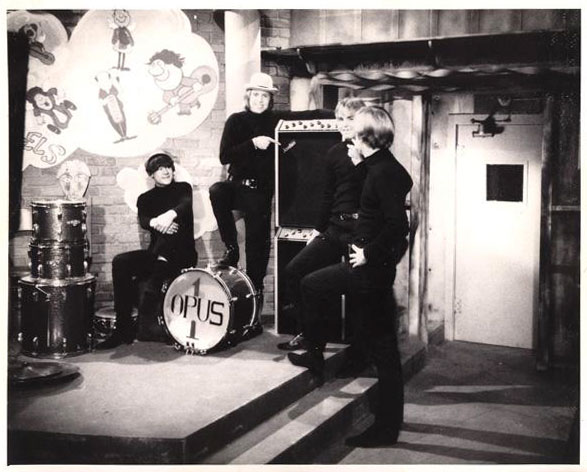
A wild Farfisa-organ and reverbed-guitar driven instrumental, save for the ghostly repeated lines "Back Seat '38 Dodge" and "What goes on... I really wanna know...". With a driving surf beat which doesn't let up and more echo than Wookey Hole, the whole record sounds like a car crash waiting to happen, and maybe that's what its slam-bang-clang finale is suggesting. Although, there is another possible interpretation...

The title was inspired by a 1964 sculpture by Edward Kienholz named "Back Seat Dodge '38" (which lyrically doesn't roll off the tongue so well). Depicting a couple drunkenly making out in said vehicle, it drew massive controversy and accusations of tastelessness and obscenity. The Los Angeles County Museum of Art, which displayed the sculpture was threatened with having its funding withdrawn unless the offending display was removed. Eventually, a compromise was made whereby the car door was kept closed unless a curious (over 18) patron requested a closer view of the interior...

Image from pictify - uploaded by user bALANelcher

The following footage is taken from a 1969 documentary on Keinholz, and shows a group of museum visitors viewing the sculpture at its original showing.

Footage copyright June Steel, from the Getty Center's Pacific Standard Time online exhibit.
Read more about the life and work of Edward Kienholz at Wikipedia

Anyway, back to the band. They were Brian Decker (lead guitar), Doug Decker (bass), Pete Parker (organ) and John Christensen (drums). All shared the minimalist vocal duties on the track. The attempt to cash in on the controversy of the exhibit didn't pay off, and the record faded into obscurity. However, hindsight is a wonderful thing and over the years the record's stature has grown. It's a classic of its kind.

Image from a great piece on Opus 1 at GarageHangover.com.

The group had a fleeting moment of fame when they appeared in an episode of Perry Mason. Sadly, they weren't performing "Back Seat '38 Dodge", but miming to a completely different group performing a track called Jersey Bounce. If you can track down the episode (Case Of The Avenging Angel) they appear to be trying to block any camera view of their personalised bass drum skin to avoid being identified. Sadly, "Back Seat '38 Dodge" would be their only release.

Another interesting footnote: A copy turned up on Ebay earlier this year. The final winning bid? Around $1700...

YouTube user blacflag made this DIY video for the record by using old moviecam footage of Las Vegas, and I think it works rather well.


WHERE TO FIND IT:

Where The Action Is! - Los Angeles Nuggets 1965-1968 (Rhino box set 2009)
Del-Fi Rarities (Repetoire CD 1993)

Or, where I first discovered it, and if you can find a copy...

Highs In The Mid-60's Vol 2 - Riot On Sunset Strip (AIP LP 1983)


Saturday, 6 July 2013

SINGLE: Paul Revere & The Raiders - Just Like Me (1965)

UK - CBS 202027 (January 1966)
US - Columbia 4-43461 (November 1965)


Paul Revere & The Raiders are, for me one of the greatest American singles bands of their time. And yes, I include their later, more pop orientated releases, although it's the garage roar of their 1965-67 run which is their most celebrated period. "Just Like Me" is their masterpiece of this phase, and also contains one of the most exciting moments in rock and roll history ever in my book.

As it stands it's already perfection from the first note. For starters Revere's organ opens proceedings, telling you these guys mean business before Mark Lindsay's vocal unleashes a torrent of angst and unrequited love. So far so good, but then comes the masterstroke. It's only 58 seconds in when guitarist Drake Levin achieves rock-and-roll immortality, letting loose with a double-tracked solo that could strip paint and break windows from 2 miles away, the rest of the band holding down the track's sub-Louie Louie riff whilst Levin sets off every fire alarm in the district. It's only 30 seconds later when, job done, Levin leaves the band to pick up the song again with a big act to follow. Somehow they manage it, and crank up the angst quotient another notch. Then, less than a minute later, the song fades, the needle lifts off the record, and you're left saying "what in the name of all that is holy... was that?!?"

Once again, the mono single mix is best, but it's well worth seeking out the stereo mix to hear that guitar solo (gasp!) separated between the left and right channels. Absolutely mind melting.

The band never had a hit in the UK. That's our loss...

WHERE TO FIND IT:

Hungry For Kicks - Singles & Choice Cuts 1965-1969 (Revola/Cherry Red CD 2009) link
Nuggets - Original Artyfacts From The First Psychedelic Era (1965-1968) (Rhino Box Set 1998)

Or for the stereo remix...

The Legend Of Paul Revere (Columbia CD 1990)

Friday, 5 July 2013

SINGLE: The Symbols - (The Best Part Of) Breaking Up (1967)

UK - President PT173 (December 1967)
US - Laurie LR3435 (March 1968)


I always had a really soft spot for this fuzz-drenched cover of The Ronettes' classic. Where Phil Spector utilised his Wall Of Sound (TM), this band from Essex went for the afore-mentioned fuzz guitar and a pounding beat which in retrospect seems like a dry run for the glam rock sound which would dominate UK pop a few years later.

My early hearings of this record were limited to oldies shows on the radio like Pick Of The Pops, as despite its top 30 placing a vinyl copy remained frustratingly elusive. Guess I was always looking in the wrong place at the wrong time, and it never seemed to crop up on any of those bargain bin 60's comps either. Having been dependent on a radio-sourced cassette recording for many years, I recently got my hands on a copy and fell for its charms all over again.

Reached no.25 in the UK, but deserved much higher, although a 12 week run is nothing to be sniffed at.

Find it on: The Best Part Of The Symbols (President CD 2004)

Read more about The Symbols at marmalade-skies.co.uk and  wikipedia.org.

Thanks to Aliconz for sharing this YouTube clip